Humanity’s dialogue with the cosmos
Read time 1 minute 30 seconds
The story of art is the story of humanity itself—our endless attempt to understand who we are, where we belong, and how we connect to the mysterious universe around us. From the moment the first cave artist traced a handprint in ochre, art became more than expression—it became communication. Each brushstroke, carving, or digital pixel tells the same story: humanity reaching out to translate the invisible forces of existence into something we can see, feel, and share.
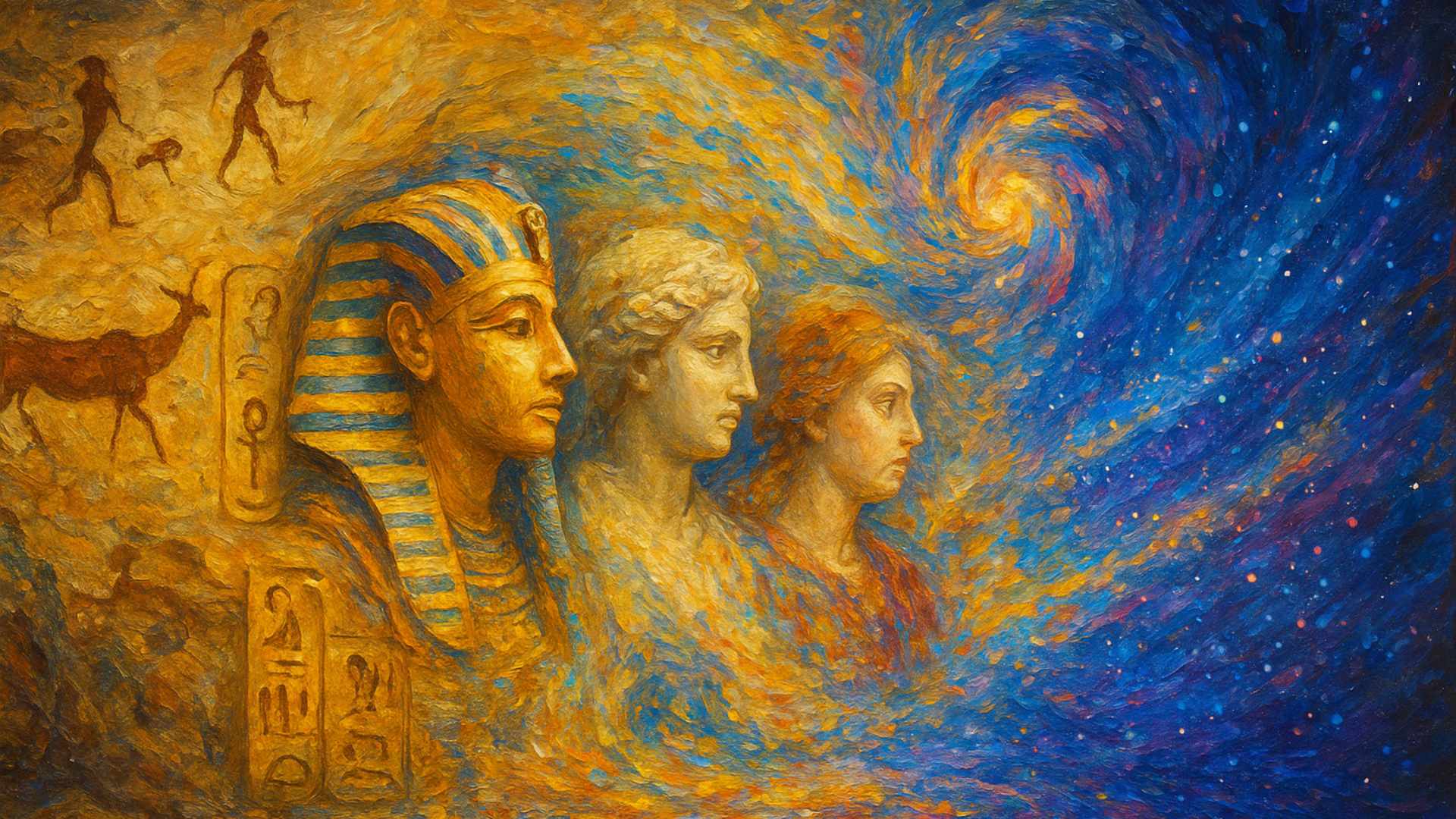
Across centuries, artists have acted as interpreters of the cosmos. The ancient cave paintings of Lascaux and Altamira weren’t mere decorations—they were portals into the unseen world. Early humans used color and symbol to connect with nature’s cycles and spiritual energies, creating art that was both sacred and deeply human. In these first creative acts, the moral and cosmic relationship between man and his universe began its visual history.
As civilizations grew, art evolved into a mirror of moral and cosmic order. Egyptian temples and tombs celebrated divine harmony and the promise of eternal life. Greek sculpture captured balance and perfection, embodying the moral ideal that beauty reflected truth. The Renaissance transformed these principles once again, merging science and spirit into a human-centered vision of the universe—proof that artistic innovation always followed the pulse of human understanding.
Modern and contemporary artists continue this ancient conversation with new tools and deeper introspection. Kandinsky and Mondrian turned music and mathematics into abstract visual languages. Rothko transformed color into emotion and transcendence. Even today, digital artists use algorithms and AI to visualize forces once thought unknowable. Each work is a miniature universe, a living laboratory where human creativity seeks to resolve moral and cosmic tensions through form, light, and imagination.
In every era, art reveals the heartbeat of humanity’s moral evolution. It is more than history—it’s a roadmap of our inner world. Whether through pigment, stone, film, or code, the artist’s mission remains timeless: to bridge the visible and the invisible, to reimagine our place in the universe, and to transform the mysteries of existence into beauty we can hold in our hands.