How Oskar Schlemmer influenced modern music video aesthetics
Read time 4 minutes 15 seconds
Oskar Schlemmer and the experimental stage culture of the Bauhaus occupy a unique and lively space in the history of modern visual media, extending beyond theater and into the world of contemporary music video. At the core of this legacy is the Triadic Ballet, a piece that feels surprisingly modern despite being created over a century ago.
Premiering in 1922, the Triadic Ballet was more than just a dance performance; it was a complete artwork. Schlemmer, who worked in painting, sculpture, and teaching at the Bauhaus, treated the stage as a space to explore the connection between the human body and abstract forms. The “triadic” concept referred to a system of three: three dancers, three acts, and an intricate interplay of costume, music, and movement. Beyond this structural framework, the ballet served as a visual philosophy, aiming to reorganize the human figure into a new geometric harmony.
The costumes are likely the most lasting and impactful part of the piece. Bulbous, metallic, spiraled, or spherical, they turn the dancers into living sculptures. Heads become orbs, limbs turn into cylinders, and torsos expand into architectural shapes. These costumes do not enhance the body’s expressiveness but rather restrict it. Movement becomes mechanical, deliberate, and oddly alien. The performers cease to be individuals expressing emotions and become parts of a larger visual system.
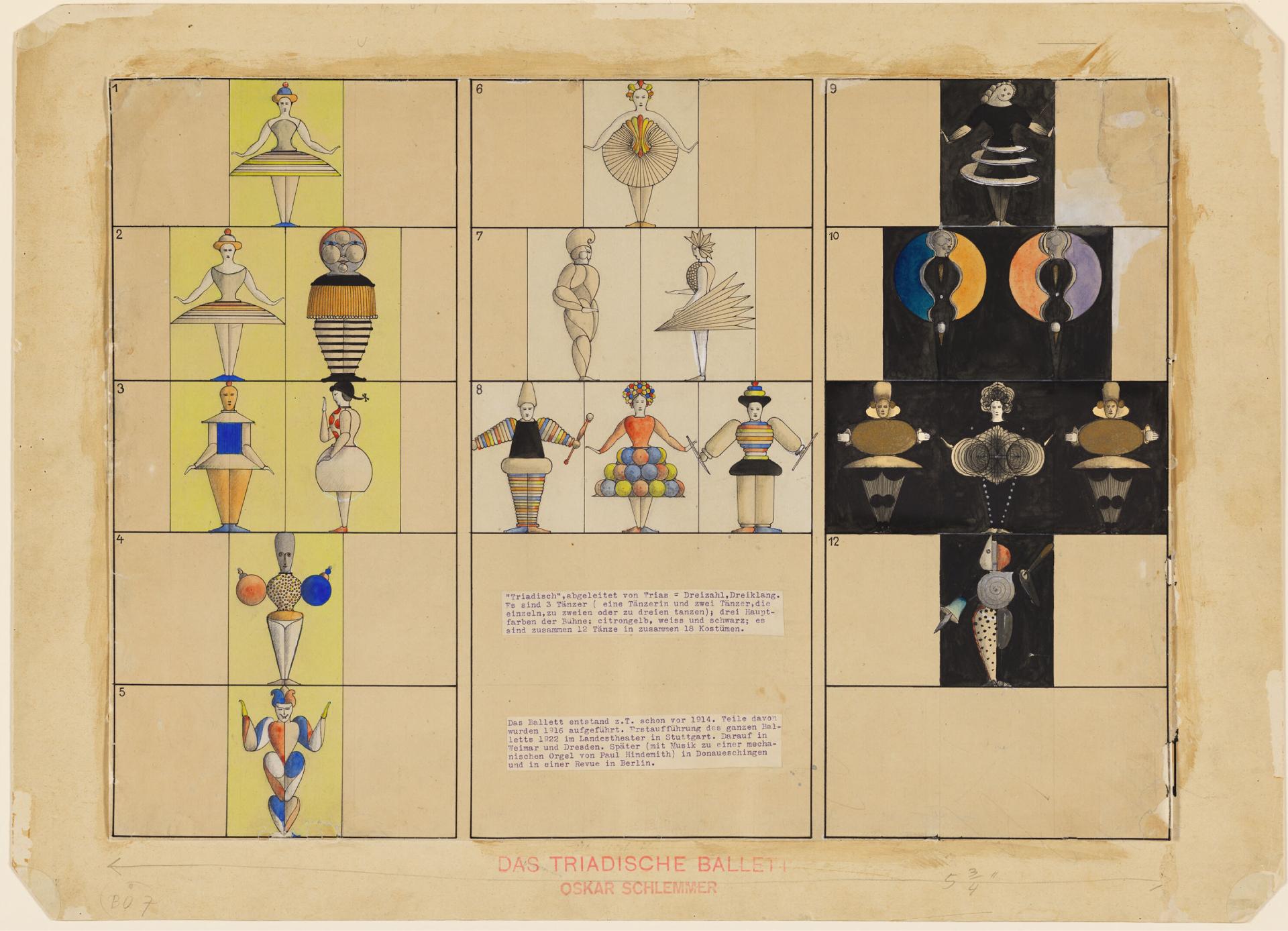
This tension between restriction and expression is crucial for understanding the work’s lasting impact. By limiting the body, Schlemmer uncovered new possibilities for movement, which felt closer to machines than to traditional dance. In doing this, he tapped into a wider cultural moment. Early 20th-century Europe was dealing with rapid industrialization, and artists were increasingly fascinated and unsettled by the growing role of machines in daily life. The Triadic Ballet reflects this ambivalence. Its figures are both playful and disconcerting, whimsical and robotic, suggesting a world where humans and machines are beginning to merge.
What makes the work feel particularly contemporary is its visual sense. The bold colors, exaggerated shapes, and surreal staging create a proto-psychedelic environment. Scenes shift from bright and playful to dark and strange, with each act presenting a new visual logic. The choreography, shaped by the limitations of the costumes, results in movements that feel algorithmic, looped, repetitive, and abstract. It’s easy to see echoes of this style in modern experimental visuals.
One of the clearest translations of Schlemmer’s ideas into pop culture appears in “True Faith” by New Order. Directed by Philippe Decouflé, the video embraces the main principles of the Triadic Ballet almost completely. Dancers move in stylized, restricted patterns, their gestures exaggerated yet oddly mechanical, reminiscent of Schlemmer’s performers. The costuming features masks, padded forms, and surreal silhouettes, turning the human body into something abstract and theatrical, blurring the lines between person and object. The staging, with its minimal sets and focus on color and spatial composition, feels like a direct descendant of Bauhaus experimentation. Instead of telling a traditional story, the video builds a visual rhythm where movement, costume, and music work as a unified whole, reflecting the triadic relationship Schlemmer envisioned. The result is a piece of pop media that feels strangely timeless, as if the avant-garde of 1922 were seamlessly translated into the visual language of the late 20th century.
Fast forward to the late 20th and early 21st centuries, and Schlemmer’s vision becomes clear in the development of music videos as an art form. Music videos, especially those leaning toward the avant-garde, often prioritize visual impact over a coherent narrative. In this way, they function much like the Triadic Ballet, using movement, color, and form to create an emotional or conceptual experience rather than a linear story.
Artists like Björk have drawn directly from this lineage. Her collaborations with directors and designers often showcase sculptural costumes that reshape the human body into something otherworldly. In videos like “All Is Full of Love,” the human form becomes mechanical, echoing Schlemmer’s interest in the intersection of flesh and machine. Similarly, Lady Gaga has created a visual identity centered on transformation through costume, using exaggerated, often restrictive designs that alter movement and perception.
Beyond specific artists, the essence of the Triadic Ballet can be found in the visual language of contemporary music videos. The use of geometric staging, synchronized and stylized movement, and costumes as primary storytelling devices all connect back to Bauhaus principles. Directors in this space often treat the human body as just one part of a larger composition, equally important as lighting, set design, or digital effects.
The growth of digital technology has only intensified these connections. Where Schlemmer used physical materials to reshape the body, modern creators employ CGI and motion capture to advance these ideas even further. Now, bodies can morph, fragment, and reassemble in ways unimaginable in 1922, yet the underlying drive remains the same: to explore the limits between the organic and the constructed.
What stands out is how the Triadic Ballet continues to seem ahead of its time. Its psychedelic, whimsical oddities are not remnants of a past avant-garde but part of an ongoing visual conversation. In a world filled with images, where attention is often captured through striking, surreal, or uncanny visuals, Schlemmer’s work feels not only relevant but foundational.
The Triadic Ballet illustrates that innovation often starts with limitations. By restricting the body, Schlemmer expanded the possibilities of visual expression. By simplifying the human figure to geometry, he found new ways of seeing movement itself. By merging costume, choreography, and space into a single system, he created a model for visual storytelling that continues to evolve today.
In the end, the link between Bauhaus theater and modern music video is not just about aesthetics; it is also philosophical. Both aim to blur the lines between disciplines, treating sound, image, and movement as interconnected parts of a single experience. In their own ways, they encourage us to rethink what it means to be human in a world increasingly shaped by design, technology, and abstraction.