Why artists get stuck and how to start again
Read time 2 minutes 40 seconds
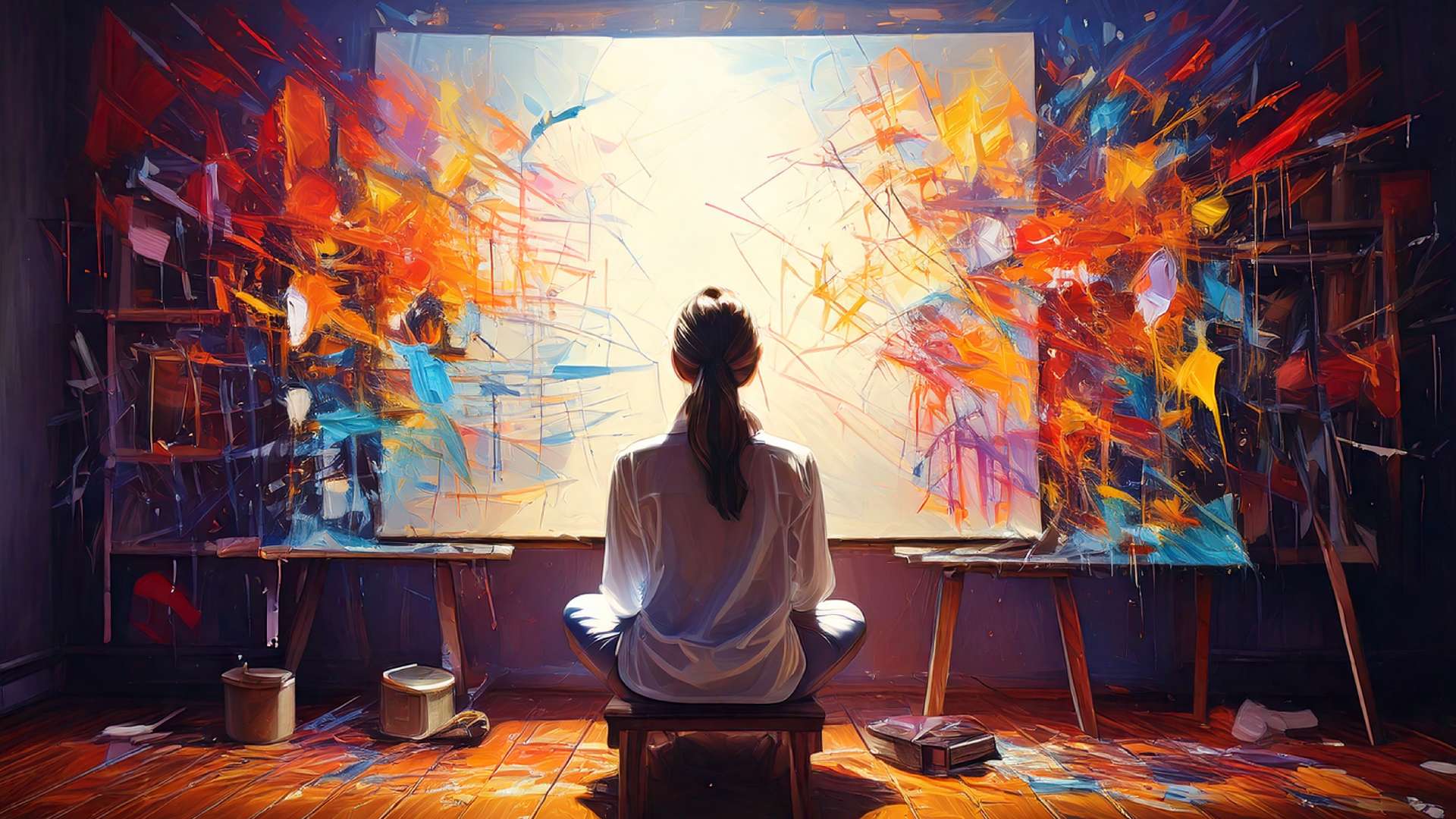
Creative blocks rarely announce themselves clearly. They arrive quietly, disguised as fatigue, distraction, or a vague resistance that is difficult to name. I remember sitting in class one afternoon, staring at a painting in progress, unable to make a single mark. There was no obvious reason. I wasn’t exhausted, nor had I lost interest in painting. In fact, the opposite was true, I cared deeply about the work in front of me. And yet, I couldn’t begin.
My professor, Chris Semergieff, noticed the hesitation and walked over. After a brief pause, he offered a piece of advice so simple it initially felt dismissive: “Just paint.” At first, I resisted the suggestion. It seemed reductive, almost naive in the face of what felt like a more complex internal barrier. But I followed it anyway. I put brush to canvas, tentatively at first. Then something shifted. The act of painting, however imperfect, generated momentum. What began as reluctance gradually transformed into engagement. The resistance dissolved not through analysis, but through action.
That moment has stayed with me, particularly in recent months as I’ve experienced a more persistent creative block. This time, the challenge hasn’t been finishing a piece, it’s been starting at all. Even opening a sketchbook has felt unusually difficult. The question becomes unavoidable: how does one move forward when the impulse to create seems absent?
A useful perspective comes from writer Stephen King, who once remarked, “Amateurs sit and wait for inspiration. The rest of us just get up and go to work.” His approach reframes creativity not as a fleeting, inspiration-driven phenomenon, but as a disciplined practice, something closer to a profession than a mystery. By treating creative work like a structured commitment, rather than a mood-dependent activity, artists can bypass the unpredictability of inspiration altogether.
Routines, in this sense, are not constraints, they are enablers. They reduce the cognitive burden of deciding when and how to begin. Instead of negotiating with yourself each day, the decision is already made. You show up, and the work follows.
But this raises an interesting question: why does something inherently expressive and spontaneous benefit from structure? Why do so many artists deliberately impose routines on a process that is often romanticized as free and intuitive?
One possible explanation is that creative block is not always the result of having too few ideas, but too many. When faced with limitless possibilities, the mind can become paralyzed. Without constraints, every potential direction competes for attention. The internal dialogue shifts from “What can I make?” to “What is the best possible thing I could make?”, a far more difficult question to answer.
In this state, perfectionism takes hold. No single idea feels sufficient, because each is measured against an infinite set of alternatives. The result is stagnation. The work never begins, not because there is nothing to say, but because there is too much.
Structure interrupts this pattern. A simple constraint, such as completing one drawing by a specific time, forces the mind to narrow its focus. The question is no longer about identifying the best idea, but about executing an idea within a defined framework. This shift is subtle but powerful. It replaces abstraction with action.
Creative momentum, then, is less about waiting for clarity and more about generating it through doing. The act itself becomes the catalyst. What begins as an obligation often evolves into genuine engagement, much like that moment in the classroom when a single brushstroke led to another, and then another.
In this way, overcoming creative block is not necessarily about solving a problem, but about changing the conditions in which the problem exists. By prioritizing process over outcome, and action over analysis, the work has a chance to reemerge one imperfect step at a time.