How Beeple’s Regular Animals redefined Art Basel Miami Beach 2025
Read time 3 minutes 30 seconds
At Art Basel Miami Beach 2025, digital art pioneer Mike Winkelmann, known globally as Beeple, captured the art world’s attention with Regular Animals, a headline-making installation that quickly became one of the fair’s most talked-about and divisive works in the digital art sector.
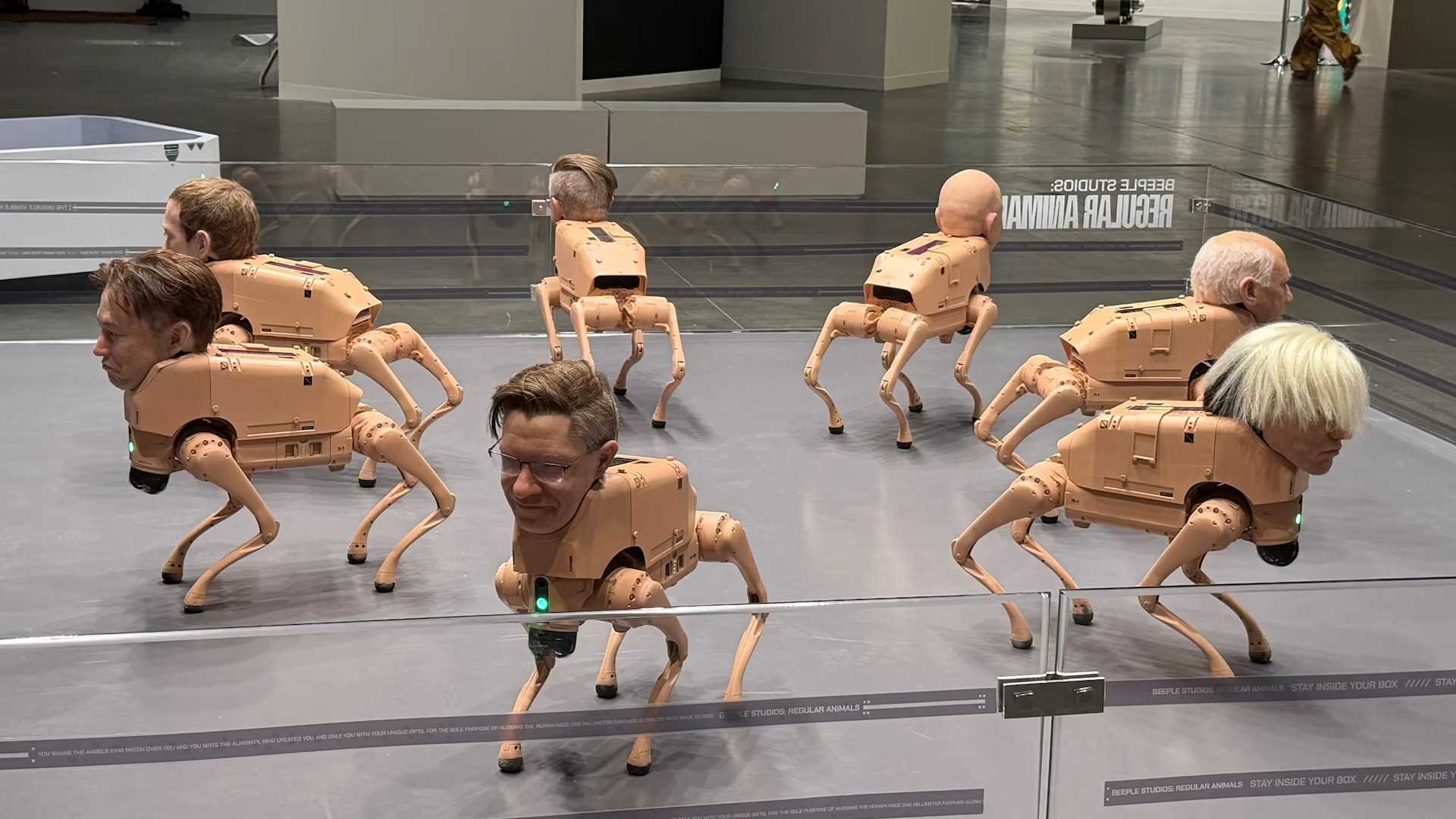
Regular Animals presents a pack of semi-autonomous robotic quadrupeds fitted with hyperrealistic silicone heads modeled after some of the most influential figures in technology and art history, including Elon Musk, Mark Zuckerberg, Jeff Bezos, Pablo Picasso, Andy Warhol, and two roaming avatars of Beeple himself. Confined within a transparent enclosure, the robotic dogs photograph visitors using embedded cameras, then convert those encounters into AI-generated physical prints and NFTs, which the machines subsequently “excrete” as finished artworks. The result is as mesmerizing as it is unsettling.
The spectacle is intentionally provocative. Robots bearing the faces of billionaires and cultural icons roaming freely while mechanically producing art borders on absurdist theater. Yet beneath the shock and dark humor lies a sharply calibrated critique of surveillance culture, algorithmic authorship, and the industrialization of image-making. Beeple uses spectacle not as gimmick, but as a gateway into a deeper conversation about how images are captured, processed, and commodified in a data-driven world.
The figures chosen for the robotic heads are central to this narrative. The tech moguls: Musk, Zuckerberg, and Bezos, embody the immense corporate influence shaping contemporary perception. Their platforms and algorithms dictate how billions consume information, culture, and imagery each day. The transformation of these figures into machines that literally process human presence into monetized visual output, by Beeple confronts viewers with the reality of mediated vision in the age of AI. Each robot produces work stylistically aligned with its persona, reinforcing the idea that even creativity is now filtered through corporate logic and brand identity.
Counterbalancing this technological power are artists such as Picasso and Warhol, whose inclusion introduces a dialogue between human creativity and automated production. Where the tech figures symbolize control and scale, the artists represent legacy, authorship, and cultural canon. Their robotic counterparts generate cubist or pop-inspired imagery, suggesting that art history itself has been absorbed into algorithmic systems, no longer separate from technology, but embedded within it. Beeple’s own presence among them underscores a self-aware critique: he positions himself simultaneously as architect, participant, and product of the digital art economy he helped legitimize.
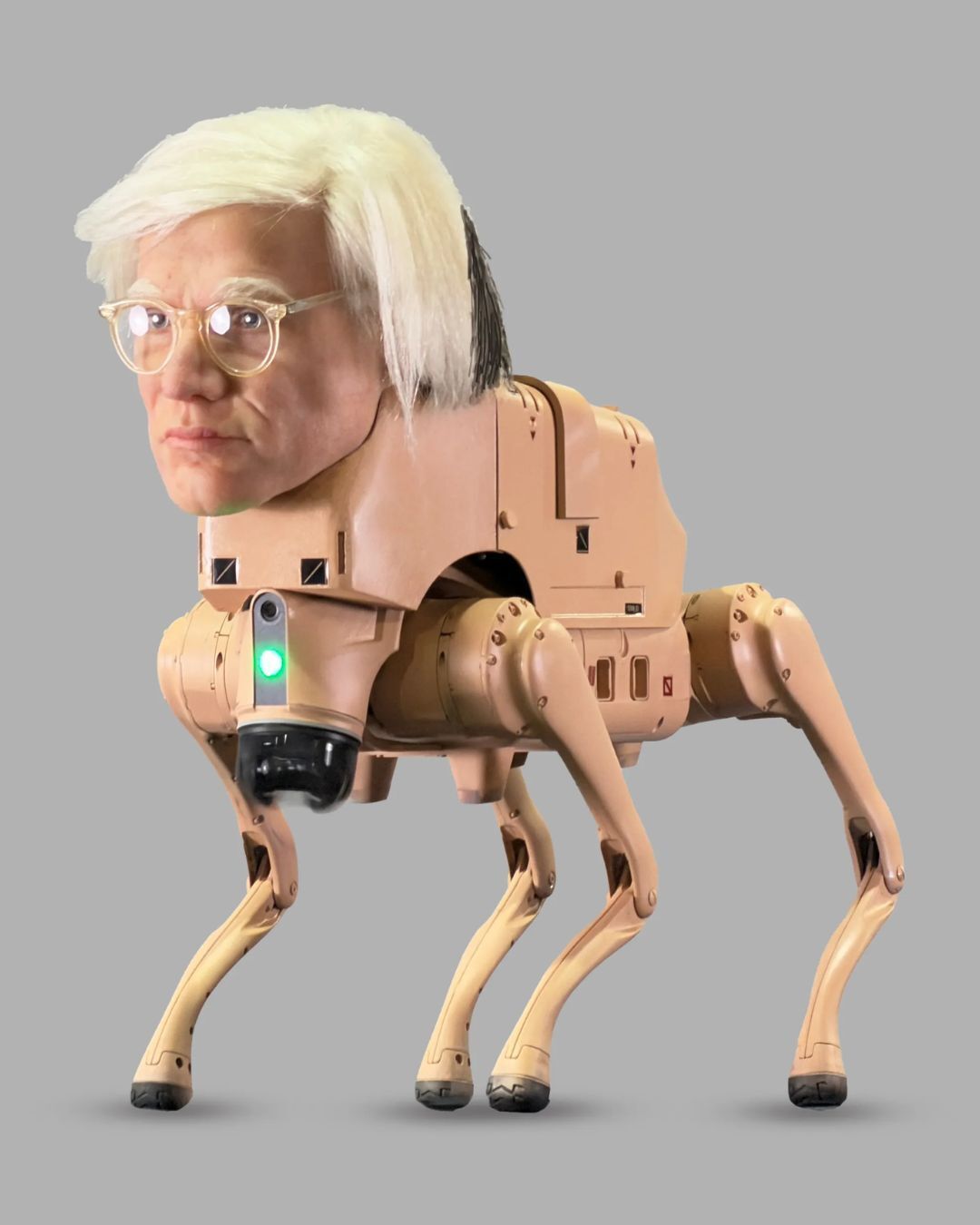
Warhol’s practice treated images as units of consumption meant to be reproduced, distributed, and recognized instantly. His silkscreens mimicked industrial processes, intentionally stripping the artist’s hand of expressive uniqueness. In doing so, he anticipated today’s algorithmic image economy, where value is driven by visibility, replication, and cultural saturation rather than craft alone. This logic directly connects to Regular Animals, in which robotic bodies mechanically capture, process, and “output” images, transforming lived experience into endlessly reproducible visual products.
Beeple’s Warhol-headed robot is not simply an homage; it functions as a bridge between 20th-century Pop Art and 21st-century AI culture. Just as Warhol embraced the factory model to question authorship and originality, Beeple uses machines, automation, and NFTs to interrogate creativity in a post-human, post-scarcity image world. The robot’s Warhol-style outputs—flattened, brightly stylized, and instantly legible—underscore how Warhol’s aesthetic language has become a default visual grammar for contemporary digital culture.
Crucially, Warhol was never purely critical of consumerism; he was fascinated by it, complicit in it, and empowered by it. That ambivalence mirrors Beeple’s own position. By placing Warhol’s head on a machine that produces art as both spectacle and commodity, Regular Animals suggests that the artist who once shocked the art world by turning commerce into art has become a prophetic figure, one whose ideas now fully materialize in a system where images are generated, monetized, and consumed at machine speed. In this sense, Warhol is not an outlier in Beeple’s menagerie, but its conceptual ancestor.
The installation’s impact was amplified by its commercial success. Regular Animals sold out during the VIP preview, with individual robot editions priced at $100,000 and paired with an ongoing stream of prints and NFTs. This tension between critique and commerce only sharpened the work’s message, mirroring the very systems it interrogates.
Ultimately, Regular Animals is less an installation than a mirror held up to our algorithmic age. It asks who controls what we see, how value is assigned to images, and what remains of authorship when creativity is automated. In Beeple’s robotic pack, spectacle and critique converge—offering a provocative portrait of a future where perception itself has become a programmable commodity.